Project Overview
The Buybye Self-Service Terminal is a physical interface designed to support checkout within Buybye autonomous stores. It provides customers with an alternative to the mobile app, allowing them to interact with the store and complete their purchases through a touchscreen terminal.
As a Product Designer, I contributed to the evolution of the experience across user flows, wireframes, UI design, prototyping, and reusable components.
The terminal is currently under continued development...
Context
The Buybye Self-Service Terminal was created to expand the autonomous retail experience beyond the mobile app. Installed in environments such as residential condominiums, universities, companies, and other private spaces, the terminal serves as a shared touchpoint used by different customers.
Because the experience takes place in a physical environment and does not rely on staff assistance, users need to quickly understand what to do at each step. The journey also needs to accommodate different shopping situations, from identifying the customer and adding products to completing payment and receiving the invoice.
Customer identification through CPF is an important part of the experience, supporting the control of age-restricted purchases such as alcoholic beverages while keeping the initial interaction straightforward.
The Buybye Self-Service Terminal was created to expand the autonomous retail experience beyond the mobile app. Installed in environments such as residential condominiums, universities, companies, and other private spaces, the terminal serves as a shared touchpoint used by different customers.
Because the experience takes place in a physical environment and does not rely on staff assistance, users need to quickly understand what to do at each step. The journey also needs to accommodate different shopping situations, from identifying the customer and adding products to completing payment and receiving the invoice.
Customer identification through CPF is an important part of the experience, supporting the control of age-restricted purchases such as alcoholic beverages while keeping the initial interaction straightforward.
Context
The Buybye Self-Service Terminal was created to expand the autonomous retail experience beyond the mobile app. Installed in environments such as residential condominiums, universities, companies, and other private spaces, the terminal serves as a shared touchpoint used by different customers.
Because the experience takes place in a physical environment and does not rely on staff assistance, users need to quickly understand what to do at each step. The journey also needs to accommodate different shopping situations, from identifying the customer and adding products to completing payment and receiving the invoice.
Customer identification through CPF is an important part of the experience, supporting the control of age-restricted purchases such as alcoholic beverages while keeping the initial interaction straightforward.
Problem Statement
The challenge was to bring the different steps of an autonomous shopping experience into one cohesive interface, while keeping the journey straightforward and efficient.
The design needed to balance business requirements with a frictionless experience, without overwhelming the customer with unnecessary interactions.
Solution / Design Strategy
The solution focused on organizing the journey into clear and predictable steps, using strong visual hierarchy, contextual guidance and touch-friendly interactions to simplify the self-service experience.
Design Insights
Benchmark
The product required a flexible interaction model capable of adapting to different shopping scenarios. This highlighted the importance of clear actions, immediate feedback, predictable navigation, and a visual hierarchy that helped users understand what to do at each moment.
The product required a flexible interaction model capable of adapting to different shopping scenarios. This highlighted the importance of clear actions, immediate feedback, predictable navigation, and a visual hierarchy that helped users understand what to do at each moment.
User Flow
The flow connects the main stages of the experience:
Start → CPF Identification → Add Products → Cart Review →
Invoice Preferences → Payment → Purchase Confirmation
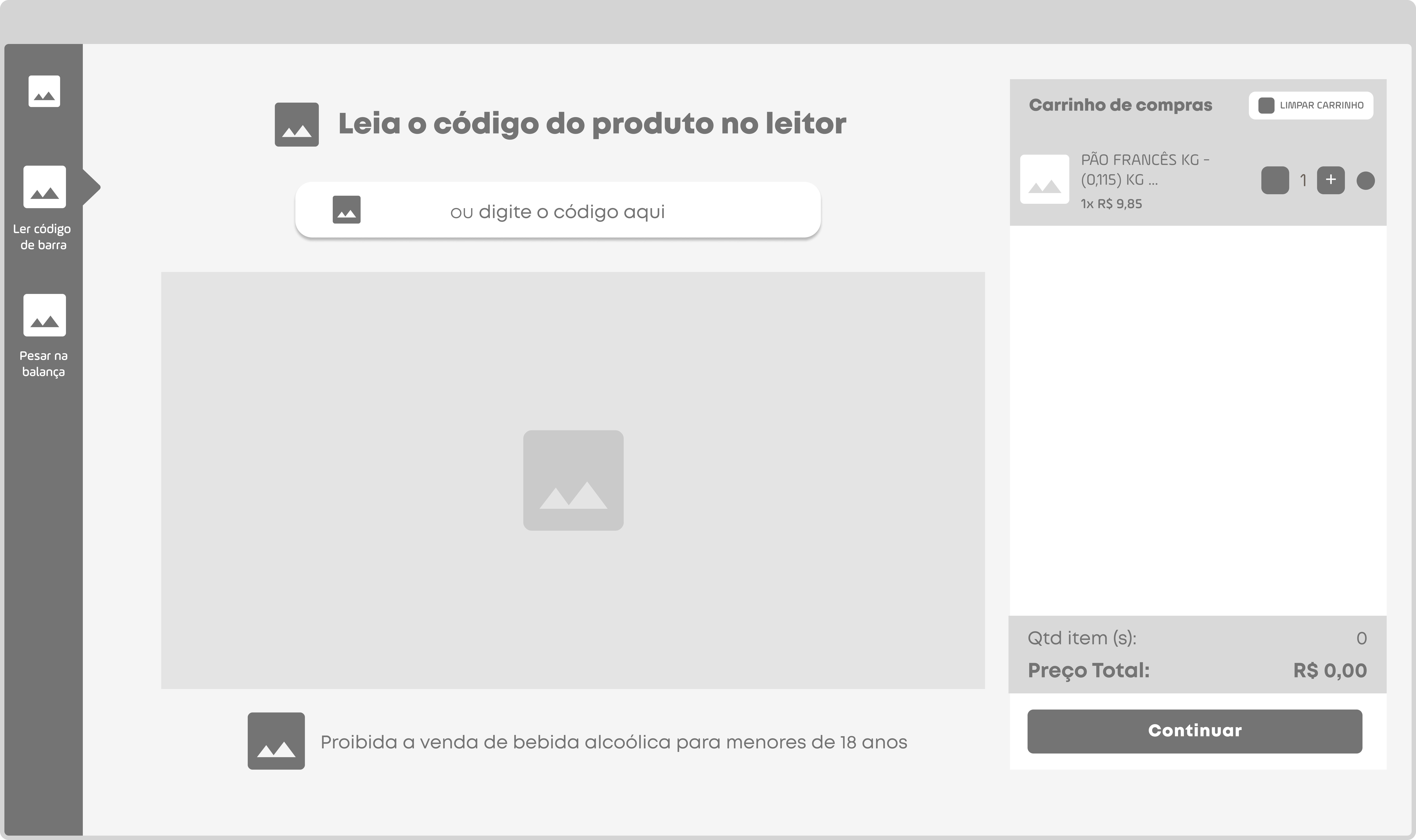
Products can be added through barcode scanning or the integrated scale before the customer reviews the purchase and completes payment.
Wireframes
Wireframes were used to define the structure, hierarchy and interaction of the main screens before moving into the final visual design.
UI Design
The UI design focused on creating a clear, intuitive, and touch-friendly interface for the self-service experience. Strong visual hierarchy, accessible typography, intuitive icons, and consistent interaction patterns were applied to make information and actions easy to understand at a glance.
The interface follows the Buybye visual language while adapting its components and layouts to the larger touchscreen environment, creating a cohesive and scalable experience across the terminal.
High-Fidelity Designs
The final screens translated the defined interaction patterns into a cohesive, touch-friendly self-service experience.
Outcome
The Buybye Self-Service Terminal remains under development, and this case reflects my contribution during my involvement in the project. I worked across the self-service journey, user flows, wireframes, UI design, reusable components, and prototyping.
Through close collaboration with the CEO and development team, I helped identify technical and business constraints and refine the experience to create a clearer, more efficient, and consistent self-service journey.
The Buybye Self-Service Terminal remains under development, and this case reflects my contribution during my involvement in the project. I worked across the self-service journey, user flows, wireframes, UI design, reusable components, and prototyping.
Through close collaboration with the CEO and development team, I helped identify technical and business constraints and refine the experience to create a clearer, more efficient, and consistent self-service journey.
The Buybye Self-Service Terminal remains under development, and this case reflects my contribution during my involvement in the project. I worked across the self-service journey, user flows, wireframes, UI design, reusable components, and prototyping.
Through close collaboration with the CEO and development team, I helped identify technical and business constraints and refine the experience to create a clearer, more efficient, and consistent self-service journey.
Lessons Learned
Working closely with the CEO and development team helped me better understand the technical and business constraints of designing a self-service terminal.
Frequent feedback and iteration were essential to identify limitations, evaluate feasibility, and simplify the experience.
The project reinforced that designing self-service products requires balancing user needs with technical constraints, business requirements and the physical context in which the interface is used.